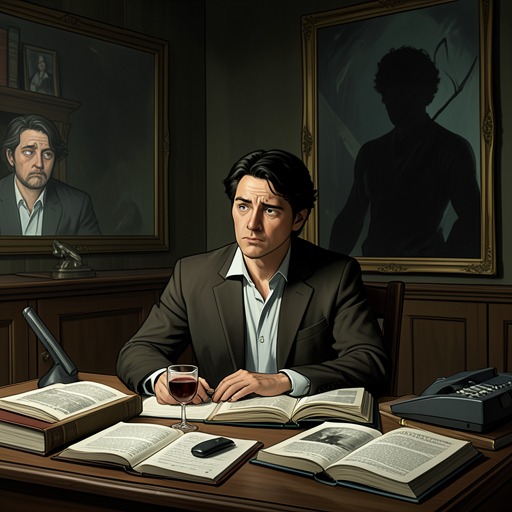
Oscar Wilde
A History of the Vampire in Popular CultureOscar Wilde matters to the history of Dracula less as a character within the novel than as a living pressure behind its creation and reception. His relationship with Bram Stoker, his connection to Florence Balcombe, and his prosecution under Victorian law illuminate the tension between public morality and private desire that the vampire became capable of embodying.
Connection to Bram Stoker
Wilde was Florence Balcombe’s childhood sweetheart before she chose Bram Stoker, yet Stoker remained in contact with Wilde throughout their adult lives. The relationship survived Wilde’s public disgrace, imprisonment, and self-imposed exile. Stoker was among the few people who visited Wilde in Paris after his release, an act of personal loyalty that gives their connection a significance beyond a passing literary acquaintance.
Stoker’s other major attachments also form part of this context. He worked closely with Henry Irving at the Lyceum Theatre for decades, while his most notable object of affection was Walt Whitman, whose Leaves of Grass was associated with sensual pleasure and the beauty of the human body. Wilde therefore belonged to a wider network of intense male relationships surrounding Stoker, even as Wilde’s fate made the social and legal risks of such attachments unmistakable.
Public Scandal and Victorian Law
Wilde’s collapse was tied to the Labouchère Amendment of 1885, which criminalised homosexuality among men under the deliberately broad category of “gross indecency.” The law supplied no clear limits or contexts for the phrase, allowing a man to be accused and prosecuted on the suspicion of a third party. A charge could therefore be shaped not only by evidence but by personal hostility or an accuser’s private motives.
Stoker had watched his close friend be brought to his knees by this legal system because of Wilde’s sexual inclinations. That experience offered a stark contrast with the freedom granted to a fictional monster. The Count could disregard polite society, pursue what he wanted, and place bloodlust and sexuality openly at the centre of his existence, whereas Wilde’s real life was disciplined by social ostracism, imprisonment, and exile.
Wilde and the Making of Dracula
The evidence does not establish that Wilde directly caused any particular element of Dracula, and Stoker’s motives cannot be known with certainty. It does, however, make Wilde an important context for reading the novel’s mingling of love, lust, violence, and moral ambiguity. Stoker may have sublimated desires that could not safely be expressed in public into a monstrous creation whose identity was not confined by accepted sexual norms.
Dracula’s force lies partly in the way the novel refuses to keep its moral categories entirely stable. The Count is murderous, but the narrative also gives him desire, purpose, and an existence outside the rules of respectable society. The story’s surface opposition between good and evil is repeatedly entangled with erotic pursuit and visceral passion. Wilde’s persecution helps explain why that imaginative freedom could carry both attraction and danger for Stoker.
Sex, Death, and Cultural Meaning
The connection between Wilde and Dracula belongs to a broader pattern in vampire fiction, where sexual intimacy and killing often occupy adjoining imaginative territory. Both involve bodily contact, surrender, danger, and the crossing of boundaries; the most popular vampire stories repeatedly portray death as almost sexual in its intensity. Dracula thus becomes a vessel for fantasies that ordinary social life demands should remain hidden, especially in cultures where deviation from accepted sexual norms could result in exclusion or death.
This reading remains necessarily cautious. Stoker might not have understood or verbalised his own desires, and later readers risk imposing present-day assumptions on Victorian lives. Even so, Wilde’s persecution gives the novel’s ambiguity a historical sharpness: fiction can permit the experience of desire without the guilt and punishment attached to it in the real world. Dracula’s supernatural excess does not erase that history; it makes the suppressed conflict visible through the figure of the vampire.
Afterlife in Vampire Culture
Wilde’s importance also extends through the later cultural history surrounding vampires. Modern portrayals increasingly allow vampires to be sympathetic, sexually transgressive, openly social, or detached from traditional evil. The genre’s continuing capacity to make bloodsucking figures whatever audiences want them to be reflects the same imaginative freedom that made Dracula more than a simple monster.
That freedom has produced both serious transformations and comic failures. The musical Lestat, adapted by Elton John and Bernie Taupin from Anne Rice’s Interview with the Vampire, was attacked by critics as undignified, stiff, and dull; one review even treated its supposed homosexuality-as-affliction allegory as part of the production’s problem. The episode shows how vampire culture continues to test the relationship between sexuality, spectacle, and respectability. Wilde’s story remains an essential historical shadow over that testing, because it demonstrates how costly the public expression of sexual identity could once be, and why the vampire has repeatedly served as an escape from those costs.